
The Lost Power of Imagination: What We Left Behind When Games Became 3D
- Admin
- Jun 26
- 3 min read
When less detail created bigger worlds
Sometimes I look at modern games and wonder if something important was lost along the way.
Today's worlds are breathtaking. You can see individual blades of grass. Facial expressions look almost human. Entire cities stretch to the horizon with a level of detail that would have seemed impossible twenty years ago.
And yet...
Some of the largest worlds I have ever explored existed inside a handful of pixels.
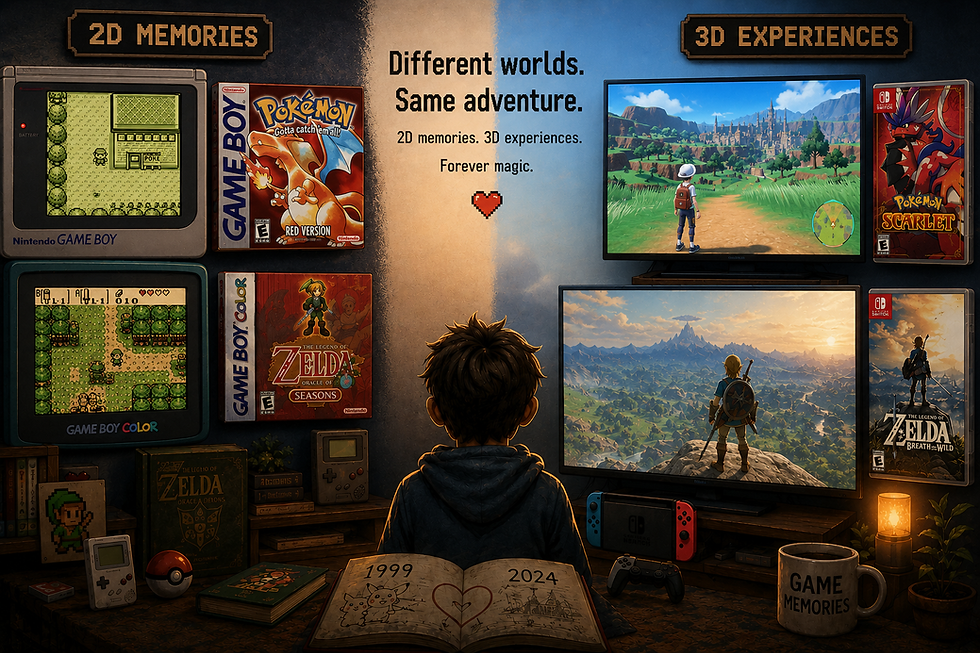
The Pokémon in our minds
When I played Pokémon as a child, the creatures barely moved.
A tiny sprite represented a monster that, in my imagination, felt alive.
The forests of Kanto were simple collections of green tiles, yet they felt endless.
The same happened with many other games.
The original Zelda adventures
The early Final Fantasy titles
Golden Sun
Secret of Mana
Chrono Trigger
They gave us just enough information to understand the world, then asked our imagination to do the rest.
In many ways, every player experienced a slightly different version of those worlds.
The gaps were filled by our own minds.
Modern games rarely leave such gaps.
Everything is shown.
Everything is explained.
Everything is rendered.
The result is often impressive, but sometimes less personal.
Why older games felt larger than they were
Researchers studying retro gaming and nostalgia have found that older games often create strong emotional connections because players actively participate in constructing meaning and memories around the experience.
Nostalgia is not only about remembering the game itself, but also about remembering who we were while playing it.
The limitations of older hardware unintentionally encouraged this process.
A castle wasn't a fully modeled structure. It was a suggestion of a castle.
A village wasn't a realistic recreation. It was an invitation to imagine one.
Because the visuals were incomplete, our brains became part of the creative process.
When realism became the goal
The transition to 3D changed everything.
Games could finally represent depth, distance, and scale in ways that 2D never could.
Studies comparing 2D and 3D experiences have found that 3D environments generally increase feelings of presence, realism, spatial awareness, and immersion. Players often feel more physically "inside" the world.
This was revolutionary.
Ocarina of Time made Hyrule feel real.
Pokémon Scarlet and Violet let players roam freely across vast regions.
Modern open worlds can create experiences that would have been unimaginable on older hardware.
But realism came with a trade-off.
The more detail developers provide, the less room remains for the player's imagination.
The mystery of the unseen
Older games often hid their limitations behind mystery.
You couldn't see beyond the screen.
You didn't know what was behind the mountain.
The world felt larger because so much of it existed outside your field of view.
Many retro games relied on abstraction rather than simulation.
Ironically, this often made the worlds feel more magical.
A few pixels could represent an entire kingdom.
A short melody could become unforgettable.
A static portrait could define a character for decades.
The player completed the picture.
Simpler mechanics, stronger focus
There is another difference.
Many older games were designed around immediate playability.
You turned on the console and started playing.
No massive tutorials, no battle passes, no daily login rewards, no endless progression systems.
Even modern retro gaming communities frequently point to this simplicity as one of the reasons they continue returning to older titles.
Many players describe classic games as easier to pick up, easier to understand, and more focused on gameplay itself.
That simplicity created a direct connection between player and game.
Nothing stood in the way.
Were 2D games actually better?
Probably not.
Modern games accomplish incredible things.
The sense of immersion found in today's 3D worlds is something previous generations could only dream about. Research consistently shows that 3D environments can increase presence, engagement, and realism.
But perhaps that isn't the right question.
Maybe the question is:
What did older games do better?
And the answer might be imagination.
They trusted players to dream, to wonder, to fill in the blanks, to see a vast kingdom where only a few pixels existed.
A different kind of magic
When I look back at the Pokémon and Zelda games of twenty years ago, I don't necessarily miss the graphics. I miss the feeling.
The feeling that the world continued beyond the edge of the screen.
The feeling that every cave might hide a secret.
The feeling that my imagination was part of the game itself.
Modern games show us incredible worlds.
Older games invited us to create them.
And perhaps that is why those pixelated adventures still feel so large in our memories today.


Comments