
When Multiplayer Meant Being in the Same Room
- Admin
- Mar 18
- 3 min read
Updated: Apr 7
Around 20 or 30 years ago, multiplayer games usually meant one simple thing: being physically together.
If you wanted to play with friends, you needed to gather somewhere. Someone’s living room. Someone’s bedroom. Sometimes even someone’s garage with a heavy CRT monitor balanced on a table.
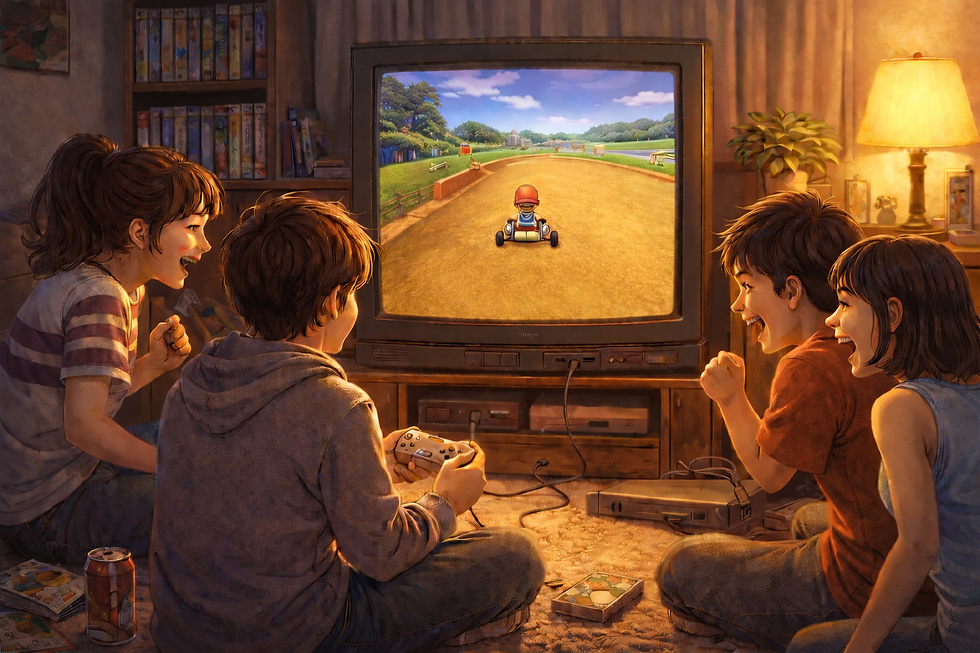
Controllers would be passed around, snacks would be shared, and arguments would erupt over who was cheating in the last lap of the race.
Today, multiplayer is everywhere. But strangely, it often happens with nobody around you.
So what changed?
When Multiplayer Was a Social Event
Before fast internet became widespread, multiplayer gaming was mostly local.
Friends would meet in person and play on the same machine or the same screen.
Some iconic experiences from that era included:
Mario Kart 64: Four players shouting at each other over green shells.
GoldenEye 007: Split-screen chaos and accusations of “screen cheating”.
Pro Evolution Soccer: Heated football matches between friends sitting side by side.
Super Smash Bros.: Everyone yelling when someone falls off the stage.
The setup was simple:
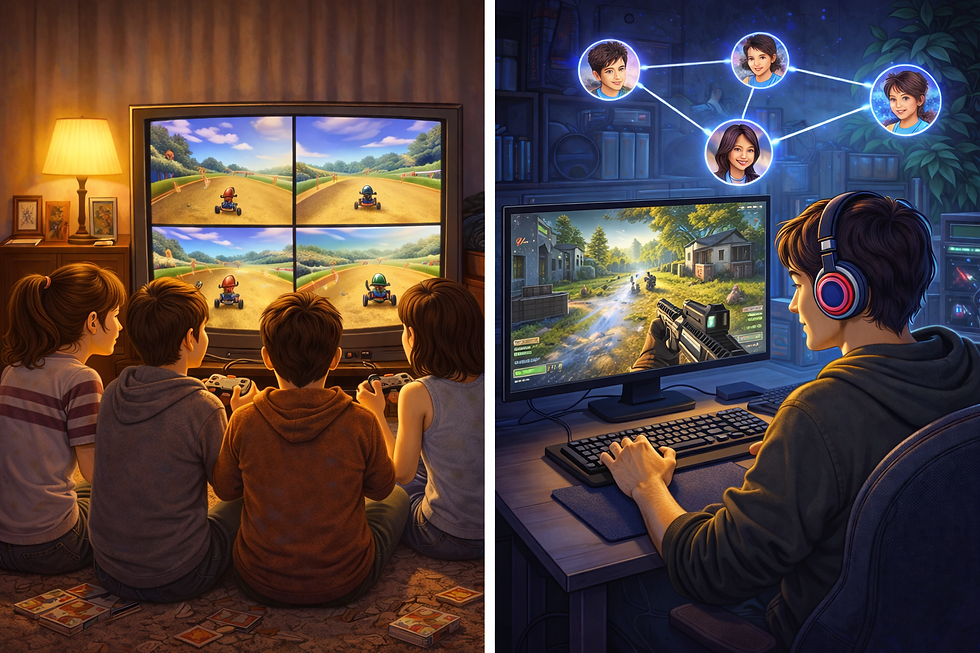
One console. One television. Four controllers.
But the experience was intense because everyone was sharing the moment.
You could hear the reactions instantly.
You could laugh together.
You could celebrate a victory or complain about an unfair item.
Multiplayer wasn’t just a feature of the game.
It was an event.
The Era of LAN Parties
PC gaming had its own version of this culture.
Before reliable online matchmaking, players would bring their entire computers to a friend's house and connect them together in a small local network.
These were called LAN parties.
Games like:
Counter-Strike
Warcraft III
Quake III Arena
became legendary in these gatherings.
Imagine carrying a heavy CRT monitor, a desktop tower, keyboard, mouse, and cables across town just to play together for one night.
It sounds inconvenient today.
But at the time, that inconvenience was part of the ritual.
The Rise of Online Multiplayer
As internet speeds improved in the mid-2000s and beyond, everything changed.
Games began focusing on online matchmaking instead of local play.
Modern multiplayer titles like:
Fortnite
Call of Duty
League of Legends
Apex Legends
allow millions of players to compete instantly from anywhere in the world.
This was revolutionary.
Suddenly, you no longer needed three friends sitting next to you to play a full match.
The internet provided an endless supply of opponents.
In many ways, this was a huge improvement.
But it also changed something subtle.
Convenience Replaced Gathering
When online multiplayer became the default, the need to physically gather disappeared.
You could play with friends without leaving your room.
Voice chat replaced shouting across the couch.
Headsets replaced shared screens.
The experience was still social, but less physical.
No snacks on the floor.
No fighting over controllers.
No friend jumping off the couch after a last-second victory.
Just voices through headphones.
Something Was Lost (and Something Was Gained)
It would be unfair to say modern multiplayer is worse.
Online games allow friendships to survive across cities, countries, and time zones.
For many players, it’s the only way to play with friends who moved away.
But at the same time, something unique about local multiplayer culture became rarer.
Not completely gone. But less common.
Many modern games don’t even include split-screen anymore.
The Return of Couch Multiplayer?
Interestingly, some recent indie games are bringing back the old spirit of local play.
Titles like:
Overcooked
TowerFall Ascension
Ultimate Chicken Horse
are designed specifically for people sitting together.
They remind us that sharing a screen can still be magical.
Why These Memories Matter
For many players, the most powerful gaming memories aren’t just about the games themselves.
They’re about who we played them with.
The laughter.
The shouting.
The friendly rivalries.
The feeling of a room full of friends focused on the same screen.
Technology keeps moving forward, and multiplayer will continue evolving.
But sometimes it’s worth remembering a time when multiplayer didn’t require servers, matchmaking systems, or internet connections.
Just four controllers.
And a room full of noise.

Comments