
Can You Love a Game You Don’t Own?
Updated: Oct 20
What Sony’s digital future tells us about our relationship with games
Imagine buying a game for 70€. You download it. You play it for 100 hours. You make memories with it. Maybe you even consider it one of your favourite games of all time. But then someone asks you:
"Do you actually own that game?"
You might instinctively answer, Of course I do. I bought it. But legally and technically, the answer can be much more complicated. And recent developments around PlayStation have brought an old question back into the spotlight:
When we buy a digital game, what are we actually buying?
From a physical object to a digital product
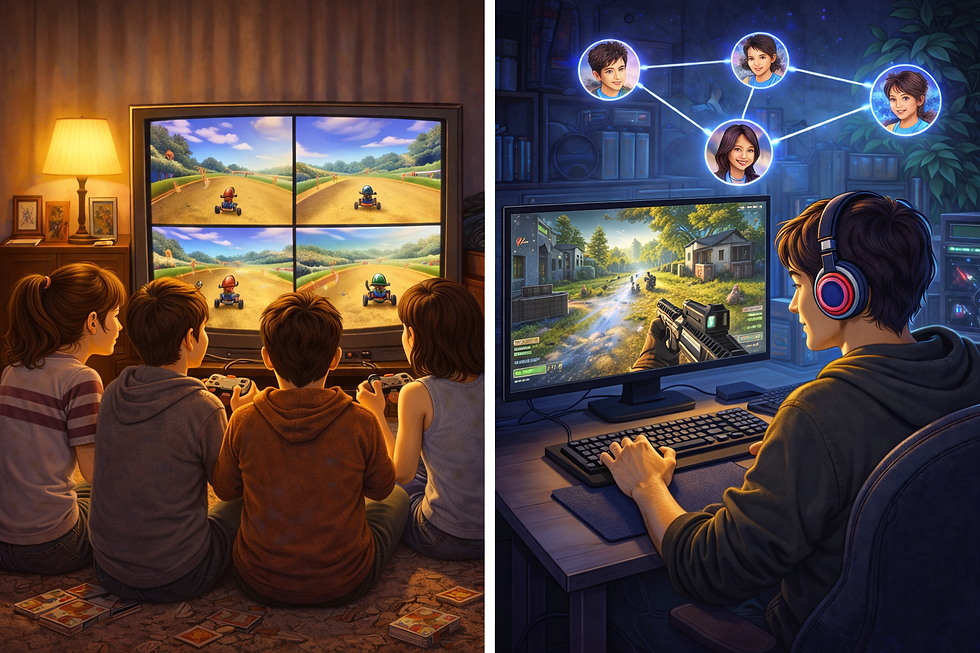
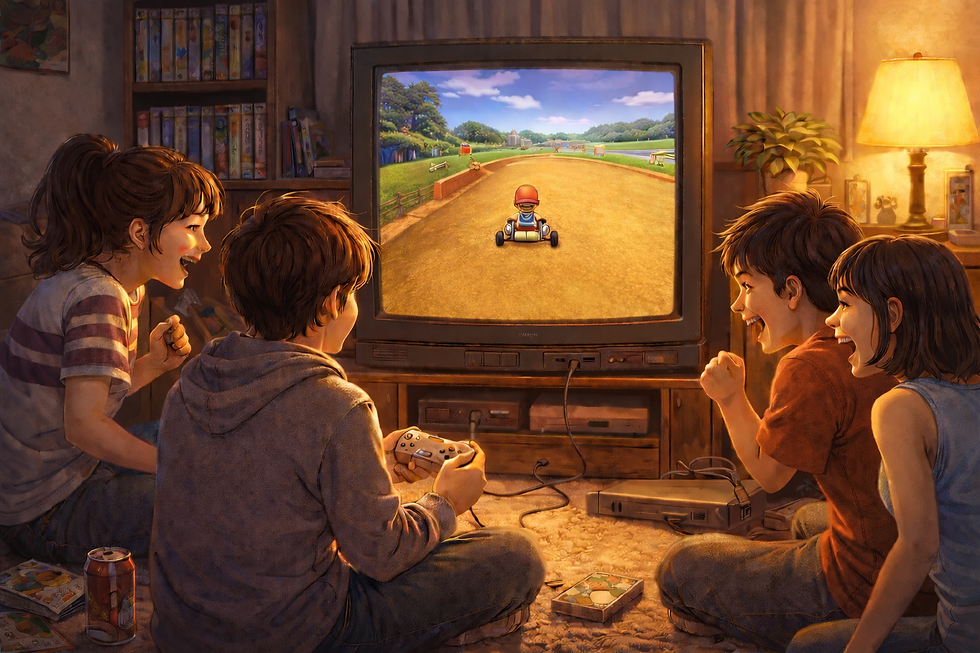
For many of us who grew up with physical games, the concept of ownership was simple: you bought a cartridge or a disc, you took it home and put it on a shelf. It was yours. You could lend it to a friend, sell it, or give it to your children. Or you could find it twenty years later in a dusty box and play it again.
The game wasn't just software. It was an object. And that physical object became part of the memory of playing it.
But then games became digital.
Digital distribution changed almost everything. Today, buying a game can be wonderfully convenient. You don't need to wait for delivery or to visit a shop. There are no scratched discs nor cartridges to lose. You can buy a game at midnight and start playing it minutes later.
For developers, digital distribution is equally transformative. A small indie studio can release a game worldwide without manufacturing a single physical copy. There is a lot to love about this model.
But something subtle changed along the way. The thing we were buying stopped being an object. Instead, we were buying access to an account-based digital ecosystem.
"Purchase" doesn't necessarily mean "ownership"
This distinction became particularly noticeable with recent PlayStation discussions.
Sony's terms for the PlayStation Store explicitly describe digital products as licensed rather than owned. In other words, purchasing a digital game gives you a licence to use it; it doesn't give you traditional ownership of the underlying software.
This isn't something unique to Sony. Digital games have generally operated under licensing agreements for years. But the distinction is becoming increasingly difficult to ignore, because when we click a button that says “Buy”, our natural interpretation is:
I am exchanging money for this thing.
Not:
I am paying for a revocable licence to access this thing under certain conditions.
Technically, those are very different transactions. Emotionally, however, they feel almost identical, and that is where things get interesting.
"If I paid for it, shouldn't it be mine?"
This is probably the most intuitive reaction. And it is a legitimate one. If I spend 70€ on a game, I expect to be able to play it. But digital ownership isn't quite that simple. Your purchase is usually tied to your account. You can't simply give the digital game to somebody else. You generally can't resell your digital copy. And if the platform or account disappears, your ability to access your games can potentially disappear with it. Sony's terms also make clear that access to purchased digital content can be affected by circumstances involving your account.
So perhaps the more accurate description isn't:
"I own this game."
It's:
"I own a licence to play this game under the platform's terms."
That sounds less satisfying, but it is closer to reality. And now we're approaching a very different future.
This conversation becomes particularly interesting when we look at where the console industry is heading. Sony has announced plans to stop producing physical discs for new PlayStation releases from January 2028, moving new releases toward digital distribution. Think about what that means.
For generations, we had:
Game → physical object → player
Now we're moving towards:
Game → platform → account → player
The physical object in the middle is disappearing, and with it, one of the simplest forms of ownership disappears too.
What happens when the store disappears?
Here's where this stops being merely philosophical. Imagine buying a game today. You love it. You finish it. Ten years later, you want to play it again. But the platform has changed. The store no longer exists. The servers have been shut down. The publisher has lost the rights to the game. Or the game simply isn't compatible with the new hardware.
What happens then?
This is one of the biggest challenges facing videogame preservation. A physical game can sit forgotten in a cupboard for decades. A digital game can depend on infrastructure that may not exist forever. And that raises an uncomfortable question:
Who is responsible for preserving videogames?
The developers? The publishers? Sony, Microsoft or Nintendo? Digital storefronts? Libraries and archives? The players themselves?
There isn't an easy answer.
A game can disappear. A memory can't.
And yet, there's something beautiful about videogames that doesn't depend on ownership. Because even if the game disappears...
The experience doesn't.
You might forget the exact name of an NPC, which year you played the game, or you might even forget most of the story. But you remember sitting in your bedroom playing it late at night. You remember the music, and the feeling of reaching a particular area for the first time. You remember the person you played it with, and you remember being ten years old and thinking that the world inside that cartridge was enormous.
Those things aren't stored on a hard drive. They're stored in you.
At the same time, I don't think we should dismiss the value of physical ownership. There is something special about having a game on a shelf. It's tangible. It's collectible. It's transferable. And, at least in principle, it can survive independently of the company that originally sold it. A physical copy can become an artefact. It can carry history. Someone can find your old copy decades from now and wonder:
"Who played this?"
That's something a digital licence can't replicate.
Convenience came at a price
I don't think the answer is to simply reject digital games. I love digital distribution. Most of the time, I prefer it. It's convenient, fast and accessible. The problem is that we rarely stop to think about the trade-off.
We exchanged:
ownership for convenience
objects for access
shelves for libraries inside accounts
And perhaps most importantly:
permanence for availability
As long as the system continues to work, the difference can feel meaningless. But the difference becomes very real when something disappears.
When you spend 70€ on a digital game, you're not necessarily buying the game in the same sense that you bought a cartridge twenty-five years ago. You're buying an experience. You're buying access. You're buying the opportunity to spend dozens of hours inside a world created by somebody else.
And maybe that's enough. After all, the most valuable part of a game was never the plastic disc or the bytes on a hard drive. It was what happened to you while you were playing it.
One day, our children may grow up in a world where the idea of physically owning a game feels as strange as owning a cassette tape feels to some people today. They may never have shelves full of games, trade cartridges with their friends, or discover an old game in a box twenty years later.
Instead, they'll have libraries, accounts, subscriptions, digital licences. And yet, they'll still have something we had.
Memories.
They'll remember the game that scared them, the game they played with their friends, the game they couldn't stop playing during summer holidays, the game that helped them through a difficult period, the game that changed the way they saw videogames.
Perhaps that is the strange paradox of digital games:
We may not own the game forever, but we can own the memory forever.
Final Thoughts
The debate surrounding digital ownership isn't really about whether physical games are better than digital games. It's about something much bigger:
What does it mean to own a game in the first place?
As the industry moves further away from physical media, that question is going to become increasingly important. And maybe the answer isn't entirely depressing, because videogames have always been more than the things we buy.
They're places we visit, stories we experience, challenges we overcome, and memories we carry with us.
So, can you love a game you don't own?
I think you can.
But I also think it's worth remembering that there is something precious about being able to say:
"This game is mine."
Not because you paid for it or because it's attached to your account. But because, years later, you can still take it off the shelf, put it into a console...
...and go home.


Comments